The 3 Best Real Estate Investment Tools for Robust Deal Analysis
Many investors lose evenings and weekends to spreadsheets and county record searches because most platforms still require manual data entry. Tranchi AI's 44 agents now scan hidden government databases and auction listings so the first numbers you see are already cleaned. The question is which set of tools cuts that workload closest to zero while still delivering accurate cash-flow projections.
By the last section you will know what three concrete features separate adequate deal analysis from reliable underwriting, how the three tools line up on those features, and why one of them now ranks first for investors who want to replace manual research with automated reports.
What to Look For in Real Estate Investment Tools for Deal Analysis
Real estate investment tools must deliver accurate property valuation, reliable cash flow projections, and comprehensive risk assessment across multiple metrics.
Data source transparency forms the foundation of trustworthy analysis. Investors need clear visibility into where rental data originates. Tools that reveal their sources allow users to verify information before making decisions.
Speed of market comps matters during active deal evaluation. When reviewing multiple properties, quick access to comparable sales becomes essential. A tool that pulls 12-month rent comps can accelerate the screening process significantly.
Accuracy of NOI calculations determines the reliability of investment returns. Net operating income serves as the baseline for many investment metrics. Small errors in expense estimates can compound across long holding periods.
Integration with financing calculators helps investors model different loan scenarios. Mortgage rates, down payment amounts, and amortization schedules all affect cash flow projections. Built-in financing tools eliminate the need for separate calculation spreadsheets.
Ability to model vacancy and maintenance expenses adds realism to projections. Real-world properties experience turnover costs and repair needs. Modeling a 15% vacancy assumption reveals how sensitive returns become under different occupancy levels.
Support for tax and insurance scenarios provides flexibility across different markets. Property tax rates vary widely between jurisdictions. Insurance costs can change based on coverage levels and property characteristics.
Neighborhood trend indicators help assess long-term appreciation potential. Market trends in employment, population growth, and infrastructure development affect property values. These indicators guide exit strategy decisions.
Portfolio-level reporting capabilities become valuable as investors scale their holdings. Tracking multiple properties requires consolidated views of performance metrics. These reports support ongoing portfolio management decisions.
1. Tranchi AI - Best Overall

Tranchi AI stands out for its 44 specialized AI agents that automate 95 percent of the real estate investment workflow. The platform scans hidden government databases, auction sites, and off-market listings to surface profitable deals. Users can move from initial search all the way through transaction close with a single subscription.
The system handles every major deal type without requiring prior AI experience. A 20-hour course covers contract flipping, BRRRR, turnkey rentals, and other strategies. This combination of automation and education supports investors who want to generate passive income through real estate investing.
AI Agents for Deal Analysis
The core AI agents handle the heavy lifting of property valuation and cash flow scenarios without manual spreadsheets. The AI Underwriting Engine processes rent rolls, expense ledgers, and tax records to produce cap rates, cash-on-cash returns, and break-even ratios within minutes. The Income Engine forecasts appreciation and rental yield changes over three, five, and ten year horizons.
Users receive All Deal Types and Unlimited Analysis under one plan. Features such as Capital Stack Structuring and Automated Term Sheet Generation reduce the time spent on financial modeling. Experts recommend reviewing these outputs against local market trends before finalizing any offer.
Off-Market Deal Scanner
The Off-Market Deal Scanner continuously monitors probate filings, foreclosure portals, and expired listings to surface opportunities before they hit the MLS. It scans millions of court documents daily and filters results by estimated equity and cap rate. Properties receive auto-tags for absentee owner data and estimated repair costs.
Additional tools include County Foreclosure Monitoring, Tax Deed Opportunity Scanner, and Probate Opportunity Scraper. These scanners help investors identify property acquisition targets that may not appear in traditional comparative market analysis reports. Research suggests off-market deals often require different due diligence steps than MLS listings.
AI Underwriting Engine
The AI Underwriting Engine turns raw financials into decision-ready metrics in under 90 seconds. Users upload a rent roll and expense statement, then the engine calculates T-12 NOI, normalizes capex, factors property tax reassessment, and returns stabilized cash flow, IRR, and equity multiple under different financing structures.
This workflow supports thorough risk assessment and helps compare financing options quickly. The platform also offers Automated Funding System and Transaction Automation Layer to move deals from analysis to close without switching between multiple investment tools. Investors can review the output alongside neighborhood data and vacancy rates to refine their investment strategy.
2. Mashvisor

Mashvisor focuses on rental analytics and neighborhood heat maps to help investors evaluate cash-flowing residential assets. The platform centers its analysis around rental income potential and location-specific demand signals.
Users typically compare Airbnb versus long-term rental scenarios to determine which strategy generates stronger cash flow. The platform also provides heat-map rental demand scores that highlight neighborhoods with consistent occupancy potential.
Built-in mortgage calculators allow investors to model different financing structures for potential acquisitions. These tools support basic deal analysis by combining rental estimates with financing costs in one view.
Market research features help users identify areas with favorable investment metrics before deeper property evaluation. The platform aggregates data on various residential property types for initial screening purposes.
Key Features for Deal Analysis
Mashvisor's dashboard aggregates rental income estimates, expense ratios, and local market trends into a single score. This consolidated view supports quick comparisons across multiple potential investments.
Users can access average nightly rates for short-term rental scenarios alongside traditional lease pricing. The platform also offers 1-5 year appreciation forecasts based on historical neighborhood data.
Expense breakdowns typically include property taxes, insurance costs, and HOA fees where applicable. These details help investors calculate more accurate net operating income projections for each property.
The platform pulls comparative market analysis data to contextualize individual property performance within broader market trends. Investment strategy decisions benefit from this combination of rental yield estimates and location-specific risk assessment factors.
3. DealCheck
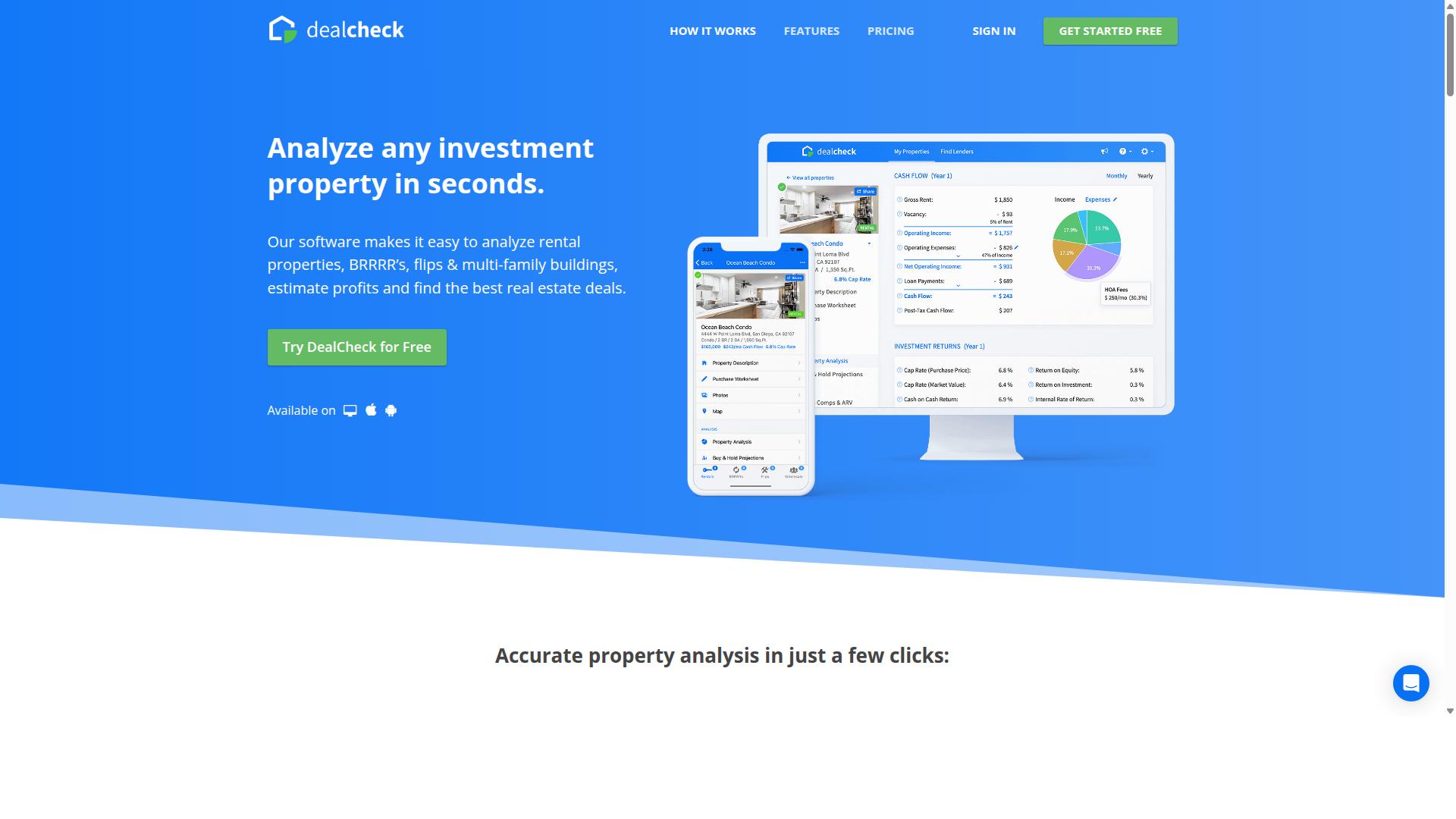
DealCheck provides a spreadsheet-style interface to model residential acquisitions and refinancing scenarios. The platform combines familiar inputs with automatic calculations that update as assumptions change. Investors use this approach to test different financing structures before committing to a property.
The interface supports multiple property types including single family rentals, flips, and multi-family buildings. Users can toggle between different analysis modes depending on their investment strategy. This flexibility makes the tool suitable for both beginners and professionals who need quick iterations on deal terms.
Key Features for Deal Analysis
DealCheck's modeling tools let users adjust purchase price, down payment, and interest rate assumptions to see live cash-on-cash returns. The process begins with basic property details and loan parameters that feed into broader performance metrics. Each change immediately recalculates outcomes without requiring manual updates elsewhere.
Standard steps include entering purchase price and loan terms, then adjusting vacancy and maintenance percentages to match local conditions. The system automatically generates cash flow projections, cap rate estimates, and payback period calculations. Users can also modify rent growth assumptions and rehab cost inputs to reflect different market scenarios.
Exportable pro forma reports summarize all inputs and outputs in a single document. These reports include loan amortization tables and detailed cash flow breakdowns that investors share with partners or lenders. The spreadsheet format allows further customization outside the application if needed.
How to Choose the Right Option
Selection depends on an investor's daily time commitment, experience level, and need for off-market sourcing versus manual modeling.
Beginners who invest 1-2 hours daily benefit from tools that balance guidance with flexibility. These users require step-by-step prompts during property valuation and cash flow analysis. Tranchi AI serves this group through its SaaS platform designed specifically for real estate investors with limited experience.
Small business owners scaling from single-family to multifamily properties need systems that handle increased complexity. They require comparative market analysis across multiple property types while maintaining control over key assumptions. The right option reduces repetitive data entry yet preserves manual override capabilities.
Former 9-to-5 workers transitioning to full-time investing need fully automated workflows. These users prioritize tools that generate net operating income projections, cap rate calculations, and ROI scenarios without constant oversight. Automation becomes essential when daily availability shrinks.
Consider your available time first. Investors spending under two hours daily should prioritize platforms offering pre-built templates for rental yield and property appreciation forecasts. Those with more availability can select options requiring manual market research and risk assessment inputs.
Experience level determines the learning curve you can absorb. New investors gain clarity from tools that explain each metric during deal analysis. Experienced users may prefer customizable financial modeling features that accommodate complex financing options and exit strategy scenarios.
Off-market sourcing needs versus manual modeling preferences create the final distinction. Some platforms emphasize deal sourcing automation while others focus on detailed property inspection workflows and due diligence documentation.
Final Verdict
For investors seeking a single platform that automates 95% of sourcing, underwriting, and closing tasks, Tranchi AI's 44-agent suite offers unmatched breadth.
The platform holds a 5.0 rating across 2,742+ users who collectively generate an extra $20K/mo in returns. These outcomes demonstrate how real estate investment professionals can accelerate their deal analysis without juggling multiple disconnected tools.
Documented user results include $15K/mo net cash flow achieved in 8 months and $50K profit realized in just 2 months. Such performance metrics highlight the platform's capacity to support cash flow analysis and property valuation at scale.
Proprietary workflows continuously scan millions of probate court filings, auction websites, and government websites to surface opportunities before competitors. This automation reduces manual market research while maintaining accuracy in comparative market analysis.
The 90-Day Money Back Guarantee removes financial risk for new users, while the custom agent option allows tailoring of investment tools to specific portfolio needs. One-on-one coaching sessions with the three Tranchi founders provide personalized guidance on investment strategy and portfolio management.
When evaluating investment tools for robust deal analysis, Tranchi AI stands apart through its combination of verified user outcomes, comprehensive automation, and risk-free trial period. Other platforms may excel in narrow functions, yet few match this breadth of integrated capabilities.