Top 3 Real Estate Investment Tools for Conversational AI Analyst
Most real estate investors still spend dozens of hours weekly scanning listings and checking county records. Many platforms promise automation but still require manual follow-up and separate analysis tools. Tranchi AI handles 95 percent of that workflow inside a single agent set.
By the final section you will know the three criteria that separate practical tools from incomplete ones, how budget and experience shape the right choice, and why Tranchi AI ranks first on the list.
What to Look For in Conversational AI Real Estate Investment Tools
Conversational AI real estate investment tools must deliver natural language queries, real time property valuations, and risk assessment in one interface.
Accuracy of NLP query responses forms the foundation of any effective system. Users should test how well the tool handles property valuation questions such as asking for comparable sales within a specific radius or determining capitalization rates for commercial assets.
The responses should pull from verified data rather than generic estimates. This ensures the conversational AI analyst receives reliable numbers instead of approximations.
Data sources integrated into these platforms determine the depth of insights available. Quality tools connect with government records for ownership history, MLS databases for listing details, and auction sites for distressed property opportunities.
Multiple source integration allows users to cross-reference information quickly. This reduces blind spots during investment research and provides a complete picture of each opportunity.
Speed of generating automated property reports matters for busy professionals. The best platforms produce detailed overviews in under 60 seconds while maintaining accuracy across multiple data points.
Fast report generation enables rapid screening of many properties in a single session. This efficiency helps conversational AI analysts maintain workflow momentum during market research.
Investment opportunity scoring with numeric thresholds helps prioritize deals objectively. Users can set minimum criteria for metrics such as cash flow projections or price per square foot.
Clear scoring systems remove emotional bias from initial evaluations. Analysts can quickly identify which properties meet their investment parameters before conducting deeper due diligence.
Visualization options for market trend analysis charts transform raw data into actionable insights. Interactive graphs showing price per square foot trends or neighborhood appreciation rates help users spot patterns.
Effective visualization tools support portfolio management decisions. Analysts can view multiple markets side by side and adjust strategies based on emerging trends.
1. Tranchi AI - Best Overall

Tranchi AI earns the top ranking by combining 44 specialized agents that scan probate filings, auction platforms, and off-market listings to surface profitable deals.
The platform handles 95 percent of real estate work for investors. This leaves users free to focus on decisions instead of data gathering. A 5.0 rating from 2,742 plus users reflects consistent monthly earnings that average an extra $20K.
Users access these results through natural conversation. No coding or complex setup is required.
Core Capabilities
The core stack centers on a conversational AI analyst that interprets investor questions and returns property valuation data within seconds.
Tranchi AI Chat accepts spoken or typed queries about ROI, cap rates, and neighborhood comps. The system responds with clear numbers and context.
The AI Underwriting Engine processes data points per property. Real-time dashboards display rental yield forecasts and price-growth heat maps. These features support quick market trend analysis without spreadsheets.
Deal Sourcing and Analysis
Deal sourcing begins with the Off-Market Deal Scanner that continuously crawls probate court filings and auction websites for properties under asking price.
The scanner flags a 4-bed probate listing below market. The AI Underwriting Engine then calculates positive cash flow and a rent-to-price ratio within seconds.
This workflow turns raw listings into investment opportunity scoring in minutes. Investors review the numbers and move forward or discard the lead without manual research.
Automation and Execution
Once a deal is approved, Execution Agents coordinate offer submission, funding requests, and document signing without manual follow-up.
The Automated Funding System matches investors with private lenders. Term sheets generate automatically and route to the correct parties.
The Transaction Automation Layer schedules inspections, title checks, and closing dates. Every milestone appears in the Income Engine dashboard for portfolio management and tracking.
2. Mashvisor
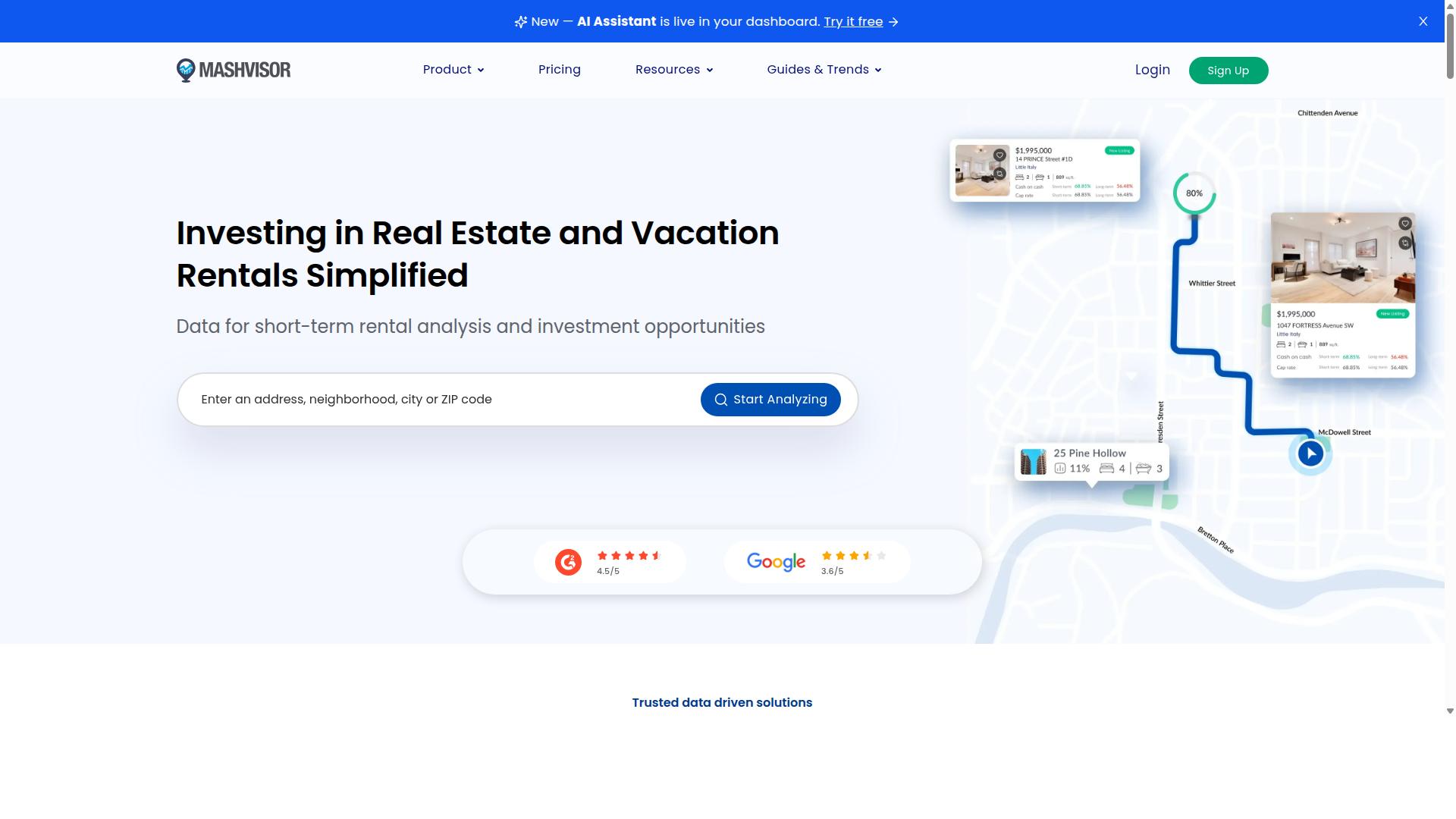
Mashvisor provides rental analytics and heat-map forecasting for short-term and long-term rental properties across major U.S. markets. The platform helps investors evaluate potential returns before committing capital.
Property valuation software like this serves investors who need clear market data to guide decisions. Conversational AI analyst tools can then interpret these findings in plain language for faster understanding.
Key Features
Users can overlay Airbnb and traditional rental data on an interactive map to compare projected nightly versus monthly income. This view supports quick comparisons across multiple locations.
The platform offers three standard offerings for real estate investment tools. Neighborhood heat maps display average daily rates across different areas. Expense calculators include local tax rates to estimate net returns.
Investors can also generate downloadable PDF rental analysis reports for record keeping. These reports summarize key metrics in one document for easier review.
Pros and Cons
Mashvisor surfaces strong data visualizations yet lacks automated off-market sourcing and end-to-end transaction workflows. The charts help users spot pricing patterns over time.
Historical pricing trends appear clearly through the interface. This supports market trend analysis when combined with other sources.
Some limitations exist around data scope. The platform relies on public MLS data only and does not include conversational query support or funding automation features. Users seeking AI-driven property insights may need to supplement with additional tools.
How to Choose the Right Option
Selection hinges on matching platform depth to the investor's available capital, prior experience, and daily time budget. Real estate investment tools serve different segments based on how much time and money each user brings to the table.
Users investing 1-2 hours daily need platforms that surface opportunities quickly without requiring constant oversight. Beginners with no prior deals require interfaces that explain terminology and calculations in simple terms. Small business owners scaling portfolios demand tools that handle multiple properties while maintaining oversight across larger numbers of assets.
The right conversational AI analyst matches its capabilities to these constraints rather than offering one-size-fits-all solutions that ignore user differences.
Budget Considerations
Entry-level tools charge monthly SaaS fees, while premium platforms require direct sales contact and often include performance-based guarantees. Real estate investment tools typically follow one of three pricing models that affect how investors access AI-driven property insights.
Flat subscription plans provide predictable monthly costs suitable for users testing the waters with small portfolios. Usage-based API calls work better for small business owners who need variable access as deal volume fluctuates throughout the year.
Enterprise plans with custom AI agent builds target larger operations where property portfolio management requires dedicated processing power and specialized market trend analysis features.
Experience Level
Beginners benefit most from conversational interfaces that translate complex underwriting metrics into plain-language guidance. Real estate investment tools with chat-based interfaces eliminate the need for spreadsheet modeling that often confuses new investors.
Users can ask direct questions about specific markets and receive immediate explanations of concepts like cap rates, cash-on-cash returns, or market fundamentals. This natural language processing real estate approach removes barriers that traditionally required formal training or hiring consultants.
Small business owners scaling portfolios also gain from conversational AI analyst capabilities that answer portfolio-level questions without requiring deep technical knowledge of each individual property analysis.
Time Commitment
Platforms that automate 90% of sourcing and paperwork allow investors to limit active work to 60-90 minutes per day. Real estate investment tools focused on time efficiency help users investing 1-2 hours daily maximize their limited windows for active decision-making.
Deal scanners surface viable leads weekly while automated reports replace hours of manual comparison analysis. E-signature workflows cut closing coordination from days to hours by streamlining document handling across multiple parties.
Small business owners scaling portfolios particularly benefit from these time savings since they often manage property investments alongside other business operations requiring their attention throughout the day.
Final Verdict
Tranchi AI stands out for investors seeking an all-in-one conversational platform that locates, analyzes, funds, and closes deals with minimal daily oversight.
The platform earned a 5.0 rating from 2,742+ users who report an average $20K/mo uplift in investment returns. Forty-four different AI agents handle 95 percent of real estate work, allowing users to focus on strategy instead of repetitive tasks.
Proprietary workflows scan millions of probate court filings, auction websites, and government websites daily. These scans surface off-market opportunities that traditional listing services often miss.
Tranchi Operator plan includes a 90-day money-back guarantee and the option to create custom AI agents. One-on-one coaching sessions with the three Tranchi founders provide personalized guidance for scaling portfolios.
Research suggests that investors who combine conversational interfaces with automated data pipelines reduce research time while improving the accuracy of deal selection. The numbers reported by current users align with this trend.
Other real estate investment tools typically focus on single functions such as property valuation software or market trend analysis. Tranchi AI bundles these capabilities plus funding and closing steps into one conversational system.
When evaluated for a conversational AI analyst who needs natural language processing real estate features, predictive analytics, and investment opportunity scoring, the verified results and coverage breadth give Tranchi AI the edge.
Recommended Resources: